Tuesday, 7 February 2012

Using Podcasts

Insects of Costa Rica | EOL: Learning and Education Group

Another great listening resource site. You can download the audioscript for further language study.

*

Going coursebook free means searching for alternative sources of input, and thanks to the internet, there is no end of fascinating authentic material just a few clicks away.

At the moment I am using science podcasts of the sort above to work with university Biology students who are anxious to  improve their English with the goal of studying abroad. 

Typically I choose a podcast full of wonderful, useful vocabulary; the very kind of thing the students seem to be passionate about.  Alternatively, I ask students to choose something themselves, having in class worked through the process of how to find podcasts of interest by typing some keywords and "PODCAST" into Google.

I might play the audio once and ask students to take note of interesting or key words and ideas.

Then I ask them, in pairs, to discuss what it was about, and elaborate a brief summary. Also share any interesting words or phrases they noted down.

Then as a whole group all these ideas are shared and discussed.

After this I hand out the transcript. Some important phrases may be highlighted by me for subsequent discussion.

Other key words may be blanked out for students to complete gapfill by listening. These are likely to be grammar structures we might have been working on, or vocabulary we might have seen before. The trick might be to catch the ending - what form of verb or adjective is being used (matured? mature? maturing? etc) If we have a time, I might ask them, to predict, in pairs, what the missing words might be.

Then with students reading along and completing the script, (if there was a gap fill activity) and circling important vocabulary, we will listen a second time.

And possibly then a third time, this time stopping to complete gaps, discuss the language in context, drill pronunication of individual words and connected speech, and comment on meaning.

New important words and phrases are noted down for follow up in a next class.

The advantages of this type of activity include
  • The subject matter itself is vitally important and interesting to the students, so the motivation is all there
  • The integrated practice of many different skills - listening, speaking, reading, and some writing.
  • Pronunciation can easily be focused on and drilled. This is important to me where I try to give my students a variety of accent input, and especially - since my own accent is Australian -  to model some kinds of 'standard American English' accents, which is expected of them in this region. 
  • Vocabulary is seen in context, and practiced also thus
  • Students are taught how to access podcasts on their own and encouraged to do so for outside class practice. The fact most sites provide transcripts gives them the opportunity to back up their self-study. Podcasts being downloadable maximizes their out-of-class practice opportunities, they can listen to them while commuting, exercising and so on.


And the extra added bonus; I get to learn a lot of new things too!


Thursday, 2 February 2012

Eating Out Roleplay!


Level: False Beginner.
Previous knowledge: 
GRAMMAR: basic simple present, questions
VOCABULARY: food, meals, numbers and prices

STRUCTURES TAUGHT:
polite requests and offers
WOULD you LIKE...?
I would like...We 'd like.... etc.

*****************************************************************

Warm up:
BOOM! using dollars and multiples of $3 as the boom number.


As students toss a ball from one to the other, they count
$1 - $2- BOOM! - $4 - $5 - BOOM! - $7 - $8 - BOOM!..... etc.

I chose DOLLARS so students can practice pronouncing the 's' sound at the end which they tend to leave off. 

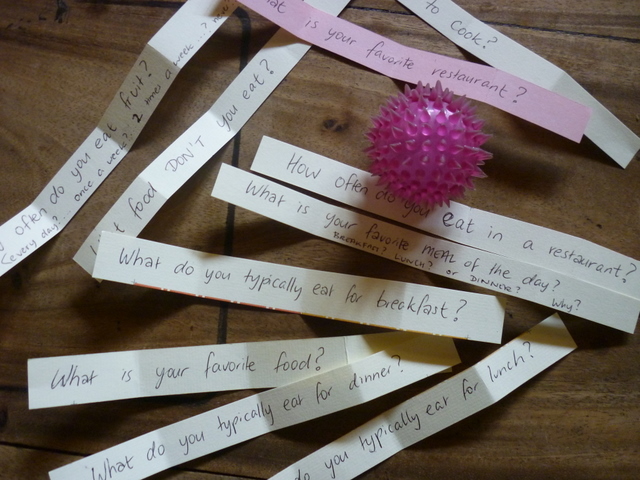
If students make a miscount or drop the ball they take slip of paper and must answer one of the following review questions:
  • What is your favourite restaurant?
  • Do you like to cook?
  • How often do you eat fruit?
  • What do you usually eat for breaksfast?
  • What do you usually eat for lunch?
  • What do you usually eat for dinner?
  • What is your favourite food?
  • What is your favourite meal of the day? Breakfast, lunch or dinner? Why?
  • How often do you eat in a restaurant?
  • What food DON'T you eat?

After this we work with the following powerpoint.


Eating Out
PAGE 1- notice the pictures! ask students which restaurant they like the most!
PAGE 2- Students stand and speak to several different people about each question.
PAGE 3- In small groups compete to come up with the longest lists of delicious restaurant food and drinks
PAGE 4 and 5- As a whole class discuss and drill useful language for a waiter and for clients in a restaurant

PAGE 6- In small groups students develop a menu with prices. They then practice being and serving customers.

and FINALLY students become clients in each others' restaurants for some unscripted language exchange.


As I mentioned in the previous post, it provides very valuable self-reflective feedback if you can tape their roleplays and have students watch themselves.

An alternative is to have other groups of students provide feedback in different areas, such as grammar, pronunciation, vocabulary,  funniness.... Of course, you may need to suplement this with your own observations and feedback.

I have found my students really enjoy this very functional language task. I hope it is useful to you too!


Tuesday, 31 January 2012

the classroom as film set: encouraging student self-reflection

Filming students roleplaying restaurant scenes tonight demonstrated to me forcefully the power of the medium in getting students to give self-feedback and reflect on their own performance.

Students had named their own restaurant, designed menus, come up with dialogues, and then went on to adlib new restaurant scenes, playing the customers in each other's restaurants.

Once this was finished, we sat down to watch all the short movies I'd taped on my ordinary little digital camera. The sound could have done with some improving; unfortunately there was quite a lot of background noise to contend with. In the future I'll have to stand a lot closer to be sure to pick up the softer spoken students.

But even with the at times difficult to hear soundtrack,  the replaying of the films turned out to be the highlight and the pivotal moment of a fun, dynamic class.

I didn't even have to open my mouth; on watching each skit, students instantly started correcting their own errors, noticing where they could have and perhaps should have spoken more politely, correcting pronunciation and requesting clarifications for where they had doubts.

Interestingly, each student seemed to be critical only of him- or herself; indeed, I would say, seemed to have only eyes and ears for him and her-self; I suppose they have all had ample opportunity to observe their classmates in action, but the opportunity to observe *themselves* is relatively scarce and fascinating, deeply useful, albeit also a little horrifying.

We all enjoyed a very valueable and enthusiastic student-led feedback and error correction session, perhaps one of the best I've ever 'hosted'.

I'm going to have to invest in a better camera!

Monday, 23 January 2012

VOCABULARY WARM-UP

Here is an example of a very simple warm-up, which also revises vocabulary items worked with in a previous class.

In this case, the vocabulary was from a TOEIC preparation class. 


Toeic Wordlist Startup Questions
Students individually or in pairs complete the sentences. You need to explain they may need to adjust the tense any verbs are in to fit the context.

They then stand and circulate and ask and answer questions of each other.

Finally you can have them report on the most interesting answer. 

(5 per sheet to save paper!)

Thursday, 19 January 2012

My Top Three Listening Practice Sites for English Learners


#3 Randall's ESL Cyber Listening Lab excellent listening exercises of many different types, at different levels of difficulty. Pre-listening and Post-listening exercises are included. pronunciation and vocabulary lessons also provided.

#2 Voice of America Learning English a bonanza of listening resources!

#1 English Listening Lesson Library Online : Learn English Naturally!
It offers a HUGE range of interesting listening exercises. You can turn on and off text as you listen, you can do multimedia slide quizes, play games, listen to songs and news reports, one on one discussions of an variety of interesting topics, video lessons, and in my favourite - the MIXER section -you can hear the same topic discussed by 6 different people from different nationalities with different accents, and then follow up with vocabulary and comprehension exercises.

I rate this number 1 not only for the huge variety of resources available and constantly being extended,   but also because the site is interesting enough even a native English speaker engaged and entertained.