Sunday, 13 November 2011

MYSTERY warm-up

Here you have an example of some warm-up questions.


Boom Mystery Questions and my particularly fabulous ball which has LIGHTS that FLASH on impact.
This was the warm-up for the following class

Level: upper intermediate

Language task being worked towards: exploring and analysing a "mystery". 

Language focus: modals of possibility and deduction, (present and past)
(Language focus, in my classes, is modelled and 'noticed' as useful for the sorts of tasks students are asked to complete, but not insisted upon)  

TASK being worked towards:
Students will choose a mystery they find interesting - for example documented ghost stories, UFO sightings, the Bermuda triangle, diverse conspiracy theories, the pyramids, the Nasca Lines, etc. 

Investigate it and then make a presentation explaining and exploring
  • the story - what is the evidence
  • what "believers" claim to have happened
  • what "experts" and "critics" explain may have happened
  • finally what the students themselves believe must have happened.

*

In this case, we played BOOM!

A quick recap on how to play:
All you need to play BOOM are
  • slips of paper with some interesting and relevant questions, 
  • and a ball or throw object

Choose a BOOM number. This number, and all it's multiples will be replaced by the word BOOM as you toss the ball from person to person, each person must count off:

eg. boom number =3
1 - 2- BOOM! - 4 - 5 - BOOM! - 7 - 8 - BOOM! - 10 ....


When the ball is dropped, or thrown badly, or the count is messed up in any way, the person responsible takes a slip of paper and answers the question.

*


This was a very small class of adult learners. I find - perhaps even more than younger students, many adults - and certainly THESE adults - truly enjoy the chance to 'play' once more. Standing up from their places and forming a circle instantly gets them smiling and engaged.


These particular learners are very talkative, and not only answered each question, but spontaneously took on the task of being moderator leading a group discussion, asking other students what they thought and believed.

The group being so talkative, the activity which might take just 15 minutes, took all of 40! My classes go for 3 hours, so as long as students are engaged and producing meaningful language, I was happy to let them go for it.

If time is pressing you can always limit the number of questions answered to curtail the activity.

*

ALTERNATIVE for a LARGE CLASS

Walk! Stop and talk!....

When classes are large - and I consider anything over 10 students as large (and in the luxury of my status of working for myself with VERY small classes, I am tempted to write 8!) - any activity where only one person is talking at any one time should be minimized.

This is specially the case for a warm-up, which should be about students loosening up and using language meaningfully, working on the fluency, exploring the topic they will work with and 'activating' the language and ideas they already have for dealing with it.

If the warm-up is to go for 15 minutes, and you have 15 students, and say 8 questions, you may have a situation where only 8 students get to actually talk for a minute or so each, and 7 might miss out altogether.

So consider, instead of BOOM!, playing "Walk! Stop and Talk!"

ALL YOU NEED: 
  • something to write questions on for all the students to see.

Of course,  if you have some technology, you can take advantage of that and use Powerpoint prompts to discuss questions. Photos can also be discussed.

Mysteries


INSTRUCTIONS:
  • tell students to stand up and WALK!  - which is generally mill around. Though depending on the class, you might get them to do silly walks or what have you.
  • when they are sufficiently mixed up, write the question out, or project the question on the board and  call out STOP - AND  TALK! Students find a partner and discuss the question. 
  • If they deal with it quickly, you might have them WALK and find a new partner for the same question, or move on to the next as you prefer. 
The advantage over BOOM; all the students in a large class have had the opportunity to participate in personal conversation for the full 15 minutes of warm-up time. =)

*

A note on local references 
My questions include two local references: the first to Costa Rica's Pre-columbian stone spheres, the second alludes to the well-known phenomenon of local money launderers going from rags to riches overnight.

You are welcome to download and use the PowerPoint, but I recommend, wherever possible, adjust activities to include references to your own local context and culture, which will make the class more relevant and engaging to your learners.


Tuesday, 8 November 2011

another exellent free online training opportunity

Some time ago I mentioned how fortunate I was to have attended a workshop given by Angela Llanas, and some of the things I learned from her.

I see now that tomorrow 9 am Costa Rica and Mexico time, pan macmillan are offering a free webinar with the very same, very wonderful Angela. If you can make it, I urge you to log on!


Saturday, 5 November 2011

3 Fun Vocabulary Warm-ups


It is news to  no one that new vocabulary must be used and re-used before it is 'owned' by the learner.

So why not combine your class warm-up with a fun and painless vocabulary review?

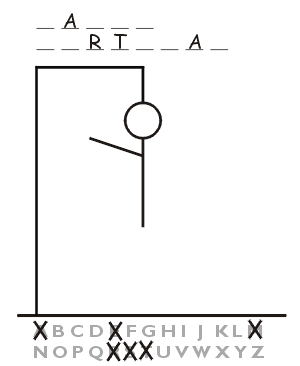
#1 HANG MAN. -

a classroom classic - and for good reason! Of course, choose challenging words you are reviewing from the previous class.  It also has the advantage of giving students important practice in spelling, something I've found they often imperfectly learn in their first English classes, and may have rarely revisited since.

Extension: Once the word is discovered, have students write a question using the word in a real,  meaningful context. Give them a few moments to circulate and ask and answer questions of each other. Discuss as a class as necessary. This is very important in giving students the chance to use the vocabulary more personally and in meaningful contexts

#2 BOOM! -
You need :
  • relevant vocabulary for review on the board or on slips of paper.
  • a ball (or pencilcase or similar that can easily be tossed and caught.)
the game is played as followed:

  • Choose a "BOOM number" - 3 is a good one to start with.
  • Students stand in a circle
  • Toss the object from student to student randomly. 
  • Each person catching the object must count as they do so.
  • Whenever they come to a multiple of the BOOM number, they must say "BOOM!" instead of the number, as follows, "1 - 2 - BOOM! - 4 - 5 - BOOM! - 7 - 8 - BOOM!"
  • Whenever someone counts incorrectly or drops or misthrows the ball, they must take a slip of paper or choose a word from the board to make a question to ask of the group.
  • repeat until all vocabulary is dealt with.

#3 CIRCUMLOCUTION
This activity has the advantage of not only reviewing important vocabulary, but also giving students practice in the important communication strategy of 'talking around' the words they lack by describing them with other words. For higher level students, having a good opportunity to painlessly and naturally practice relative clauses is a bonus extra.

Once again all you need are the words written on slips of paper.
Students can be placed in teams which have their members take it in turn to choose a word.
This they must describe until their teammates identifies the word.

For example, if the word were say PAINTING, the student might say, "It is thing you put on the wall. It is art. They have many of them in an art gallery..."     

Points can be given to the teams if your class enjoys competition.
3 points for a word guessed correctly with the first students identification.
If the student is unsure of the meaning of the word, or if her teammates are unable to identify the meaning of the word, another team member can join her - but the team will only earn 2 points. 
Of course, any point system can be varied according to what works with the group.


*
As discussed in a previous post all important incidental vocabulary that comes up during a class can be recorded in a margin of the board for this type of follow-up use in the next class.

It is important to tell students they will be 'tested' on the vocabulary in the coming class.

Their delight on discovering the 'testing' is all in good fun does not diminish the formation of a habit of taking careful note of new vocabulary by knowing that it will be important to them in the coming class.

If you have any ideas to add, I'd be delighted to hear them!

I find one of the most important things is to vary warm-ups so that your classes are never predicitable.

Enjoy!


Tuesday, 18 October 2011

Quick Fixes: making book work more engaging part 2: 'THE ACCURACY CASINO'

OK, so you have to do a certain amount of 'accuracy' exercises in your classes.

You have to
'work through'

and
'fill in'
 
the book.

As I suggested in a previous post,that is no reason why the dynamic and communicative part of your class needs to come to a sudden (ugly) stop.

I mentioned having students work in small groups to resolve and then change again to discuss problems.

A further suggestion on how to expediate the 'filling in of the book'  without compromising dynamism  - and even stimulating dynamic language analysis:

Play 'ACCURACY CASINO':


Let's suppose there are 10 problems in a given book exercise to resolve.

  • Put students into small groups. Rather than having each group complete every item, share the items out among the groups such that each group completes only one or two items. (If giving them 2 items, make it one from the early part and one from the late part of the set, as typically exercises start with easier items and become more challenging.)
  • Have groups write their answers on the board; Now the board is complete with 10 solutions, which may or may not be 'correct'.
 HERE IS WHERE you switch from BOOK MODE, switch into GAME MODE to play ACCURACY CASINO.
  • each group starts with 100 points with which to 'BET'.
  • ask how much of their 100 points they wish to bet on ITEM #1 solution, as it appears on the board, being correct.
  • give each group analysis time and time to decide their BET amount.
  • keep a record of bets made alongside the item.
  • finally discuss and have students explain why the answer was, in fact, correct or incorrect. 
  • add or subtract points from each groups 'betting fund' accordingly.
  • students write the 'corrected' example in their books. 
  • Continue with other items.
The group at the end with the most 'points' wins.

You should find this leads to extremely motivating, dynamic and effective language analysis, which sees 'the book' completed without the pain, strain and dull dull dull tediousness so often associated with bookwork.

Enjoy!

And please do share any other ideas you might have!

Friday, 7 October 2011

Quick Fixes: making 'book work' more engaging

You've done the fun stuff. Watched some funny skits for input. Students have come up with and presented their own versions, given each other feedback and analysed together some common errors.

Now it's time for the dreaded dull bit: time to open your books. Grammar exercises. Focussed book practice. You can't avoid it, working through the book is required by the institution. Or perhaps you don't even wish to avoid it, some focussed practice is necessary to round-out your students' mastery of what you're working on.

But suddenly your high-energy, highly student-centred class comes crashing back down to normal old classroom-land with a thud and a yawn.

So how can you keep the energy zinging and at the same time have your students more dynamically engaged with the learning process?
Easy!

  • have them work in pairs or small groups - instantly they must discuss and negotiate their answers and be more dynamically engaged with the subject matter. The number of skills being used rises, from the classic book reading and writing, they must also listen and speak, postulate, defend and negotiate answers.
  • have them switch partners to check answers. Monitor to check they are on the right path. Often 'whole group' checking may be proven unnecessary. 
  • another excellent alternative is while small groups work on exercises in their books, have particular groups come up and write their answers on the board. When they have finished, have them pass the marker on to another group. This provides for excellent and easy group discussion of any problem areas.
  • if there is something incorrect,  you can identify the problem area by underlining it and then hand the marker onto another group to have them try to propose a solution.
Students engage more actively and meaningfully with the problems they are working on, as they struggle collectively to come up with the answers. They also engage more communicative skills. More learning styles are catered to - there is student-generated visual as well as the classic auditory checking, and the kinesthetics of standing writing on the board, handing the marker on, switching partners stops them from yawning and tuning out.


Working with books does not have to be downtime!

Do you have any other book-work gems to share?